Saturday, October 27, 2012

Blog Post #8

1. Richard Miller: This Is How We Dream

In part one of Richard Miller's video, This Is How We Dream, he talks about how writing in the academy has changed and how writing in culture has changed. We have the capability to communicate globally instantly. He states that this is the greatest change in communication in human history. Richard Miller talks about growing up in a time where writing was a solitary activity that took place amongst the companion of books. Books are print based documents that are solo-authored and usually found in libraries. Now, books are virtual. He talks about change that has happened over time. Where and how we work used to consist of pencil and paper. Now, we carry our laptops everywhere and work in word processing. Now, not only do we have the library to use, but we also have everything we need to know on the web to do our research.

Richard Miller also talks about how he was asked to write an article in response to the one year anniversary of the killings at Virginia Tech., and how he wrote the entire article without ever stepping foot into a library. He connected his own thoughts and reflections about the certainty that campus violence remains with us to the cultural and social commitments to violence that was recorded in government documents and in the voting patterns of presidential candidates that year. This article is in print and can also be found on the web. It is freely available and can not be removed. This gives us the possibilities to share knowledge infinitely. Another change is the ability we have to compose with film, images, and audio from the web. We now have the ability to create visual documents.

multimedia
In part two of Richard Miller's video, he states that in a digital environment, we are confronted with new material. It changes before our own eyes and is updated instantly. It can be composed with education productions and even iTunesU. Not only can we look at and use this material, but we can go inside and see how it is put together. We can create and produce alternative versions and stories and distribute that information globally and freely. There are no limitations or restrictions with this material. He states that people are starting to realize that ideas do not belong to us individually, but as a culture. We as educators or future educators, must be in the business of sharing ideas freely.

Richard Miller states that he foresees a time when students will compose not with word processors, but will compose digitally. This idea is already in motion because there are people now composing with the web itself instead of using images. This is a way to push ideas into our culture. This is visual literacy and he and his team are working on a way to make this digital network available in our educational system.

After watching both videos, my reaction was wow!! The idea that my students will be possibly using this kind of multimedia in their everyday learning completely amazes me. Richard Miller definitely states a true fact when he says that we live in a moment in which this is the greatest change in communication in all of human history. The way we communicate with one another and communicate globally should show that we live in a world of endless possibilities. Communication is extremely important in our culture, so of course we are going to try to find new ways to improve it.

This idea of visual literacy and students composing digitally with this new multimedia seems amazing, but it does raise a few concerns for me. If students are able to manipulate the web in such a way, then are they actually learning anything? The use of pencil and paper has already been reduced drastically in schools today. If we eliminate paper and pencil completely, how do we know if the information being taught to the students will actually stick? For many students, information is more easily remembered when written down.

I think that we are becoming too dependent on technology. This multimedia is a prime example. I don't understand why we need this in our education system and why students need to compose this way. I don't understand how my students will actually retain any of the information being taught if they are constantly in front of a computer. I'm trying to have an open mind with the use of all this technology in my future classrooms, but I'm having a difficult time doing that. I just feel like what's the point in becoming a teacher if technology is doing almost all of the teaching for me!

2. Carly Pugh's Blog Post #12 Assignment

In Carly Pugh's Blog Post #12, her assignment is to create an assignment that she feels is a good enough idea that Dr. Strange himself should have assigned it. She stated that as future educators, we should all be thinking about our philosophies as teachers. In the assignment that she created, her instructions were to create a YouTube playlist with at least ten videos that:
1. Describe the kind of teacher you would like to be.
2. Show ways you can motivate your students.
3. Offer tips on classroom management.
4. Offer tutorials on programs you have learned about in this class that you would like to use (podcast, iPods, PLN's, ect.).
5. Are on topics related to your field of study.
6. Describe what a good teacher is and what a bad teacher is.
7. Ways to improve modern education as we know it.
8. Have been used in other blog posts from this semester.
9. Center around creativity.
10. Advocate challenging, motivating, encouraging, and supporting students (but still maintain professionalism).
Include at least five of these topics. Explain how these videos describe your teaching philosophy and relate to things you have learned in this class. What could you do with them in your teaching environment?

Carly then created her own playlist and followed the instructions she had given for her own assignment. She stated that good teachers teach by example. She described what each video meant to her teaching philosophy and how she could use them in her teaching environment. She stated that modern technology can assist in the education and growth of our youth, and that more is available out there other than videos. We need to use these available resources to keep the attention of our digital learners.

I thought that the assignment that Carly created was brilliant. It was extremely creative and you could definitely tell that she put a lot of thought and effort into it. Carly's post seemed like it was right on track to Dr. Miller's description of his hopes for writing with multimedia. She composed an assignment that was written in a blog post that contained several different digital videos. Each video assisted in the explanation of her teaching philosophies in a fun and interesting way that text would not. The videos were funny and kept the attention of her audience or digital learners. Carly's post is the perfect example of what it means to write with multimedia. She did an excellent job.

I read the comments on Carly's blog post in search of an explanation of why this was an assignment. I came to the conclusion that this was an assignment to help us see all the benefits EDM310 offers us on our journey to become educators. When we leave EDM310, we will have a better understanding of the different types of technology used in education and how to use each one to assist us so that we are the best teachers we can possibly be.

3. EDM310 is Different

The Chipper Series is a student produced video that demonstrates how hard life can be when you do not do what you are supposed to do. Chipper is a student in college and thought that she could turn in her work late, procrastinate, and just be taught so that she didn't have to learn, and would still pass college. With this thinking, college became very hard for her and she dropped out of school. She started her own college and was quickly shut down because she was letting her students choose when and how long they had to go to school. Chipper bounced around from job to job getting fired from each one. She had a change of heart and decided that she would go back to school. But this time, she would do her work right and on time.

The primary message in this video is that you will not be successful if you don't do what you are supposed to do and do your assignments on time. It is your responsibility to do your work in enough time that it will not be submitted late. You are in school to better yourself and be successful in the career that you have chosen. So do the right thing now!

EDM310
In EDM310 for Dummies, another student produced video, two students are driven crazy due to EDM310. They do not understand twitter, skype, delicious, and google docs or how they are to be used. They purchase a book that saves their lives. EDM310 for Dummies has all the tutorials needed to explain everything in EDM310 and how it works. The students are now stress free and have a better understanding of their class.

The primary message in this video is that if you don't understand how to do something in your assignments, don't get stressed out. Just go buy the book and it will explain everything you need to know.

Since EDM310 has so many assignments that need to be completed every week, I would like to create a video demonstrating how to manage your time and assignments wisely. By completing at least one of your assignments due for the week every night, you won't have all your work piled up on you. Therefore, you will not have to rush to complete it all on time.

4. Learn to Change, Change to Learn

The video, Learn to Change, Change to Learn, was about the change that needs to take place in our education system. Teachers from all around made their own personal thoughts and opinions about today's education system. It was stated in the beginning that the U.S. Department of Commerce ranked fifty-five industry sectors on their level of intensiveness. Education was ranked number fifty-five. Someone said that children have a much more stimulating environment outside of school than they are inside school. Everyday they are texting, emailing, updating Facebook statuses, and making connections with other people all around the world. This isn't allowed in schools. Their main source of communication is being taken away. Educators need to realize the importance of technology and its use in the classrooms. Technology builds bridges that connects students to what is going on all around the world. It gives students the opportunity to expand their knowledge and better prepares them for not only college, but for life as well.

Right now a student's knowledge is based solely on standardized and state testing. Every student must be on the same standardized level. This is what teachers are told to teach. With this way of learning, genius and creativity goes right out the door. By having standardized and state testing, the only thing we are accomplishing is a student's memorization skills.

Many teachers aren't comfortable with technology because they do not know how to use it and apply it themselves. If teachers were given the tools needed to communicate with other teachers globally to exchange ideas and ask questions, they might view technology differently. With technology, 21st century learning is going to be based on what you can do with information. Do you know how to find information and do you know how to validate it? Do you know how to synthasize information, leverage information, and communicate it? Do you know how to collaborate information and problem solve with it? This is the 21st century of literacies that will soon be taught in all education systems around the world.

After watching this video, I am realizing that the more I learn about how technology can be used in education, the more I am realizing that there are actually a lot of positives about it. I completely agreed with a lot of what the teachers in the video were saying. I think that standardized testing needs to be changed or done away with completely. Why do we want every student to be on the exact same level? I understand the idea behind "No Child Left Behind." But a huge downfall of that idea is that we no longer have genius students who could possibly be the next Einstein. We no longer have creative or artistic students. Their talents and true capabilities are suppressed because their knowledge is on a standard level. This is where technology comes in and the importance of its use in education becomes acknowledged. There are so many different types of technology and so many different ways that it can be used, that it tests a students level of thinking in every way possible. Technology can reach into your mind and expose hidden talents and creativeness and show everyone what you are truly capable of.

The students of today are going to be our future leaders in this world. They are our future doctors, lawyers, educators, and politicians. Don't you think it's important for them to have the knowledge, understanding, and capabilities of technology so that they will be able to communicate globally in the future? This is why it is so important that students learn how to use technology and exchange information now. We live in a fast-paced world and technology changes everyday. Therefore, we need to teach students how to use technology properly and in a professional manner to better prepare them for the future.

5. Scavenger Hunt 2.0

Discovery Education's WEB 20.11 website had several different educational tools that can be used by teachers and students. I found three of them.

1. Create a comic using makebeliefscomix.com. This is my comic.


2. I found a video tool using Animoto. This video tool can be used by teachers, students, and classroom audiences. It is specifically designed to help bring your lessons to life. One of its many special features is that it automatically organizes a custom video for you. It does this by automatically analyzing your music, photos, and video clips. This leaves you plenty of free time to focus on the content and narratives of your video. I love this feature because organizing music, photos, and video clips in a video can be extremely time consuming. Therefore, you lose focus on the content and why it's important. With the use of this tool, that problem is solved.

3. By using the presentation tool Prezi, you can create presentations and slideshows. This program offers you a 30 day free trail. When your free trial ends, you must purchase this program if you wish to continue using it. Prezi offers a special price for students and teachers. It is $0 per year if you purchase Prezi EDU Enjoy. If you decided to purchase Prezi EDU PRO, it is $4.92 a month. That is significantly cheaper than the normal price of $13.25 a month. By being a student or teacher, you get a much better price.

Sunday, October 21, 2012

C4T #2

The Nuts and Bolts of Flipping

Amanda Ooten, a science teacher, describes in her post how she makes her videos that her students watch on their own time in her flipped classroom. She states that the end goal in the idea, flipping the classroom, is to have more class time, one on one, with students to dig deeper into the material through activities, labs, and real-world problem solving. So what is exactly is a flipped classroom? A flipped class consists of videos, made by student's teachers, that have the next day's lecture on them. Students watch these videos at home so that there is less lecture time in class and more one on one with students and teachers. The videos are usually 10-15 minutes in length and include everything students need to know about each chapter. Tasks and assignments are assigned during the video that the students will discuss the next day in class. Assignments help the students become more involved with the material besides just reading and watching the videos.
Many different programs are used to create the videos such as Screenflow, Camtasia, Screenium, Jing, CamStudio, and iShowU. It usually takes a total of three hours per screencast for preparation, recording, and editing. Amanda states that the product is well worth the time and hopefully the videos can be used for many years.

Comment #1

I commented and said that I have read articles and watched videos about how to flip a classroom and what exactly that meant. After learning what it means to flip a classroom, I wasn't sure if I wanted to do it in my future classrooms. I guess I feel that if the students are watching a video at home and in class, students have group activities, then what is my role as a teacher?
But after reading her post, I told her that flipping the classroom seems like a great idea. I now see the benefits and different opportunities students and teachers have when the classroom is flipped. I gave her a big thank you for helping me to see that this is a more efficient way of teaching and that by flipping your classroom, your students will learn more.

My Flipped Classroom, Part 2

After two months in her flipped classroom, Amanda Ooten wrote a reflection describing the impact this new way of learning had on her and her students. She said at first, her students were overwhelmed with this new concept. They were spending more time on their "at-home" assignments and videos and weren't fully understanding all the concepts that they needed to. They were asking more questions in class, therefore, Amanda was spending more time lecturing. She did some rethinking and flipped her classrooms only 50%. She realized that some concepts need direct instruction at such an advanced level of learning. Her students still watched videos and had "at-home" assignments, but there was also lecture time and in-class discussions. She felt that she was a better teacher because of the flip. She was finally teaching her class the way she wanted to instead of the way the College Board tells you to teach.

Comment #2

I commented and said that I was really glad that she did some rethinking and decided to flip her classroom only 50%. I told her that she was definitely right. Some concepts are difficult to understand at certain learning levels and need to be taught by direct instruction from the teacher. I gave her credit for acknowledging the fact that there needs to be a balance between the amount of lecture time needed and the amount of "at-home" assignments students need to complete. It seemed as though her students really enjoyed this way of learning and so did she. I then congratulated her on her success.

Wednesday, October 17, 2012

C4K September Summary

C4K #1

In C4K assignment #1, I commented on a teacher's class blog. Anthony Capps is a third grade teacher at Gulf Shores Elementary School. In his blog post, "The Buzz About Jobs," he discusses how his class has been studying the elements that make a successful community. They have also been discussing what makes a community member productive. As a class, they decided that productive community members work together, practice patience, encourage each other, help each other understand, follow directions, and lead each other. They also created a wordle using a list of jobs that the class thought was most important in their community. Some of these jobs were firemen, doctors, engineers, bank tellers, teachers, and repair men. There were several other jobs listed as well.

I commented and stated that I agreed with them on their thoughts about productive community members. When community members come together and work as a team, they can be extremely productive and accomplish many thoughts, ideas, and goals. I mentioned that I was going to school to be a teacher, which was one of the jobs that was listed. I stated that I thought that being a teacher is probably one of the most important jobs in a community, and that I couldn't wait to become a part of that.

C4K #2

In C4K assignment #2, I commented on Mason's blog, a student in Mrs. Krebs science class in Iowa. His blog post was entitled, "Finding Out About the Kentucky Coffee Tree." He talked about how he found a dichotomous key from Iowa State University. He stated that he learned that a Kentucky Coffee Tree had opposite leaves and not alternate leaves. Mason also included a link where he found his information from.

I commented and told Mason that I didn't know that trees had different types of leaves. I also told him that his link to Iowa's Trees was very informative and interesting. I gave him some positive feedback and told Mason that I enjoyed reading his blog post. I even asked him a question to give him a chance to respond back. I asked him if Kentucky Coffee Trees really did produce coffee beans.

Tuesday, October 16, 2012

Blog Post #7

The Networked Student

The Networked Student, created by Wendy Drexler, depicts an actual project completed by her own high school students. In her video, she tries to give parents, teachers, colleagues, and students a better understanding of how networked learning works.

The video starts off with a 21st century high school student studying American Psychology. He meets in class three days a week and two days online. There are no books and the teacher hardly ever lectures. She is a student of connectivism.

So what is connectivism? "Connectivism is a theory that presumes learning occurs as part of a social network of many diverse connections and ties." The student uses many different resources and communication tools to collect facts and create his/her own thoughts and reflections about his/her topic on a blog he/she creates. Tools such as google search, wikis, blogs, and rss makes it easier for students to connect with new contacts and to learn effectively with the ones he already knows. What a great way to integrate technology in the classrooms!

So the question is asked "Why does a networked student even need a teacher?"

According to Wendy Drexler's video, the following is a list of reasons why a networked student needs a teacher:
1. His teacher is the one that teaches him how to build these networks and take advantage of learning opportunities.
2. She offers guidance when he gets stuck.
3. She shows him how to communicate properly and ask respectively for help from the experts.
4. She shows him how to differentiate between good information and not so good information.
5. She shows him how to vent a resource.
6. She shows him how to turn a web search into a scavenger hunt, and to get excited when he finds that pearl of content.
7. She helps him organize those mountains of information.
8. In her heart, she hopes that when he leaves her class, he will maintain his learning network and use it to navigate his future and creatively solve the world's problems.

After watching the video, the same question, "Why does the networked student even need a teacher?," popped into my mind. I understand that technology is extremely important in the classrooms because teachers need to be up to date on today's technology and how it is used. But why? The answer to that question is because we live in a fast-paced world that is in a state of constant change mainly due to the advancements of technology everyday.

As a future educator, I'm worried that one day teachers will become completely obsolete as a result of technology and will then be replaced and no longer needed. If you really sit and think about it, technology is already starting to take over. Schools now are starting to replace textbooks with ebooks. Students have a computerized tablet that they connect to the school's network and download the reading material that they need for that particular class. White boards and chalk boards are slowly being replaced with SMART boards. This SMART board is connected to a computer.

I have recently learned that teachers are no longer teaching students cursive handwriting. Cursive handwriting was such a big deal with teachers when I was in grade school. I remember hating my teachers in fourth, fifth, and sixth grade because all written work, which was just about everything we did, had to be written in cursive handwriting.

In schools today, even first and second graders are required to have flash drives so that their assignments done on the computer can be saved. This is already starting to eliminate the amount of actual writing, pencil to paper, that students do. When everything has to be typed and done on the computer, there is no need for actual writing. At this rate, schools will soon just omit learning how to write so that students will have more computer time.

I'm not bashing technology being used in classrooms nor am I saying that technology in education is a bad idea. There are several advantages and positive thoughts I have about integrating technology in the classrooms. But does anyone ever look at the negatives about this transformation in the education system? Everyone is different and processes information in a different way. Technology is not going to adhere to everyone's unique learning process. This is why we need excellent teachers so that no student is left behind.

So NO, I don't want to be a networked teacher. I want to be more involved than that with my students. After all, aren't teachers supposed to teach their students instead of sticking them in front of a computer and trying to make them learn something they don't know on their own?


2. A 7th Grader's Personal Learning Environment(PLE)

PLE
In the video, a 7th grader demonstrated how she uses her Personal Learning Environment every day in her science class. She discusses how every morning she checks the science agenda to see what she will be doing in class that day. Sometimes she has a video to watch and sometimes it's just assignments that need to be completed. She created a blog in which she post assignments and writes her reflections about what she did in class that day. She says that she really enjoys this way of learning because she has so much freedom. She is able to choose when and how she completes her assignments. She says that everything is done online, so there aren't any books, and everything is neat and organized. She says that she loves networked learning.

This 7th grade student's PLE seems almost identical to my Personal Learning Environment for EDM 310. There are no books because everything is done online. I have to check to see what assignments and projects I have for that week. Sometimes there are videos that I have to watch and post my reflections in my blog for class. This class is definitely unlike any other that I've ever taken before. It's a completely different way of learning because you aren't sitting in front of your teacher everyday. As of right now, I think that I'm a little undecided on whether or not I like this networked learning. I guess I will just have to see how the rest of the semester goes.

Tuesday, October 9, 2012

Project #9a

Ashley Zaworski's Timeline

Blog Post #6

Randy Pausch's Last Lecture

Randy Pausch
Randy Pausch died July 25, 2008 of pancreatic cancer. Before he died, he gave his last lecture.His lecture was amazing and extremely inspirational. I was blown away and really wish that I had been there in person to hear it.

Randy Pausch talked about three different things in his last lecture. The first thing he talked about was his childhood dreams. Some of his dreams were being in zero gravity, playing in the NFL, meeting Captain Kirk, and authoring an article in the World Book encyclepedia. He then described how he made all his childhood dreams come true.

Second thing he talked about was enabling the dreams of others. He stated that it wouldn't do any good if just his childhood dreams came true, he wanted to the childhood dreams of other's come true. He developed a program that did just that called The Dream Fullfillment Factory. This program was all about making people's childhood dreams a reality.

Randy Pausch was also involved in several other projects including Building Virtual Worlds, which was a course he designed in which students built virtual worlds. He was involved in the project Aladin at Walt Disney World which was a virtual world that took you on a magic carpet ride. He was also involved in the creation of Alice which is a novel way to teach computer programming.

He also talked about an idea called "head-fake." So what is "head-fake?" Randy said that the best way to teach someone is to make them think that they are learning about something else. He used this idea in Alice. Students thought they were building games when they were actually learning how to program. What a great idea and a creative way to teach.

The last thing he talked about was lessons he learned. He says help others, loyalty is a two-way street, don't complain, work harder. Some other important lessons Randy said that he learned was not to bail. He said "the best gold is at the bottom of the barrels of crap." He also said never give up. I think that these two lessons go hand in hand. Life is hard and when you are trying to make your dreams come true, it can get even harder. But if you never give up and you don't bail, you might surprise yourself in what you can accomplish.

Several of the things that he discussed in his lecture I would definitely use in my teachings. For example, I think that the whole "head-fake" idea is great. It's a way to make learning fun for your students without them even knowing that they are learning something. The lessons that Randy stated that he learned are definitely great morals that I would use in my teachings as well. I believe that teachers not only teach math, english, science, and history, but teachers are role models. Teachers also teach their students morals and how they should act as decent human beings in society and in life. Teachers teach their students the difference between right and wrong, what to do and what not to do.

In Randy Pausch's last lecture, the "head-fake" was about life. Being good at something makes you valuable. Apologize when you mess up. Give gratitude to people always. Find the best in everybody. And last but not least, brick walls are there to make us prove how badly we want something.

His last lecture was amazing. This was a man that was dying and still had such a positive outlook on life. I definitely encourage everyone to watch his lecture. I hope it inspires you like it inspired me!

Friday, September 28, 2012

Blog Post #5

1. The iSchool Initiative

Travis Allen made some very good arguments in his video The iSchool Initiative. School budgets are being cut, teachers are getting layed off, and classes are getting larger. He created the iSchool Initiative in hopes that one day, all schools will adopt this idea and become and iSchool. An iSchool does not use paper, pencil, copy machines, or books. Every student and teacher will have an iTouch that has iSchool apps.
ischool apps
There are apps for everything a student needs to learn and teachers need to teach. Books, workbooks, and library books are available with the touch of a finger. There is an app for note taking. iHomework is an app students use for homework. There are apps for scientific calculators, world and geography maps, and any science and math formula a student will ever use. Attendance, grades, and assignments are all recorded on the iTouch. The use of this technology in schools saves approximately $600 per student and only costs $150 per student. Travis hopes that with this initiative, people will see that technology is needed in classrooms today.

One of my biggest concerns that I have is the replacement of teachers in the classrooms. With technology advancing so rapidly, what if there comes a day where teachers are no longer needed? The education system is already in the process of deleting things that are no longer useful. Books are being replaced with computerized notebooks and soon students will not need to know how to write. Why? Everything is typed and done on computers. Writing is slowly becoming unimportant in education. I fear that soon, teachers will be replaced as well.

2. Eric Whitacre's Virtual Choir

I was completely amazed after watching Eric Whitacre's Virtual Choir. His choir consisted of 185 people from all around the world. They performed 'Lux Aurumque' and it was uploaded to You Tube.
virtual choir
I would have never guessed that these people had never performed together before. They were so in tune with one another, you'd swear that they had performed a thousand times before together. This video shows you that with the use of the internet, anything is possible. It is truly astounding what people can do with the internet. I've never seen the internet used quite like this before.

3. Teaching in the 21st Century

In this video, Kevin Roberts ask the question, What does it mean to teach in the 21st century? Teachers are not the main source of knowledge anymore. Why? Students can find out information on anything, anywhere, and anytime. Resources such as Facebook, Google, Twitter, Wikipedia, and many others give students all the information that they need. Teaching in the 21st century no longer consists of teaching just facts and content. Teachers need to be teaching students skills as well. In this fast-paced technological world, students need to know how to use all these resources properly. They need to know how to blog, how to comment, how to create podcasts and upload video to You Tube. Students also need to be taught how to handle these resources in a professional manner. Students still need to know the basic concepts remember, understand, apply, analyze, evaluate, and create. These basic concepts are extremely important to their education. And even though the tools that are used have changed from books, pencil, and paper to iPods, iPads, and cellphones, teachers can still teach students lessons that are relevant, challenging, and engaging.

As a future educator, it seems as though I am going to have to be on top of my game with my knowledge of technology. I am going to have to know how to use all the different resources available so that I can incorporate it with lessons I teach my students. Learning how to teach students in the 21st century is definitely going to be a challenge. I don't know everything I should about technology right now, but I am trying to catch up. It makes me a little nervous, but I'm sure that by the time I have my first class of students, I will know everything I need to know about teaching students in the 21st century.

4. The Flipped Classroom

In the first video I watched, Katie Gimbar, and eighth grade math teacher, discusses why she flipped her classroom. She states that ninety percent of class time is spent on delivery and review of the content. This means that most of the time, she is standing in front of the classroom lecturing. Ten percent of class time is spent on application of the content. This means that this is the time where students are actually applying what they learned in some activity. Before the flip, she was teaching to the middle group of the class. There was a group of higher level students in the back of the classroom that was bored with the material, and a group of struggling students that were being left behind.

classroom
Flipping the classroom consists of lecture videos that are made by the teacher for students. Students watch these videos at home before class the next day. They can pause, rewind, and re-watch the videos as many times as necessary. Students are able to post questions in a forum and the material is self-paced. Students know the content before class the next day. Therefore, ninety percent of class time is spent on application of the content, and ten percent on delivery of the content. It is more efficient for both teachers and students.

The second video is about Dr. Lodge McCammon and his program FIZZ. Dr. McCammon came up with the concept of flipping the classroom. He stated that he believes that there is too much lecturing in classrooms today which is one of education's biggest problems. All that time that teachers spend lecturing is not efficient and the students aren't engaged. He developed the program FIZZ, which trains teachers how to flip their classrooms and gives them a better understanding on how the concept "Flipping the Classroom" works.

I thought the concept of flipping the classroom was very interesting, but I don't think that I would use it in my teachings. Students already spend the majority of their days in school. Now we are giving them lecture videos to watch at home too? It just seems like there would be too many issues and conflicts with this concept. I really don't understand how you could teach your students a lesson through a video, and your students actually learn the concept. If you really feel that your students are not engaged in your lectures, then obviously the problem is you. It is part of your job as a teacher to create activities that go along with your lecture that will have your students engaged. You do not have to flip your classroom to do this.

Sunday, September 23, 2012

Project #5 Presentation

Blog Post #4

Preparation For Podcast

Langwitche's 1st Grade Read Along Book

Langwitche explains in this post how the students created their own audio read along book. She worked with the classroom teacher to create the interview script. The script was recorded with the students as they read the book chapter by chapter.
Children's Podcast
After the scripts had been recorded, she created a booklet for each of the students using a template in Microsoft Word. They played the podcast and her students were able to listen to the audio while following along in their little booklets.
I think that this is a really great idea when you are creating your own podcast, especially if you have to present it in front of an audience. Sometimes, you can't hear or understand what someone is saying in a podcast. If that is the case, then a read along book would definitely give you a better understanding of what the author of the podcast is trying to present.

Langwitche's Listening-Comprehensive-Podcasting

In this post, Langwitche highlights the importance of listening (hearing) and comprehension in podcasts. She describes hearing not only as hearing the sounds of the letters that make up a word, but also the context. You have to hear all of the words around it and hear the flow of the sentence to help you understand what is being said. She also states how important language is. When you are speaking in any language, be sure to put emotion and feeling into your words by using pronunciation, volume, and tone. This gives your language a meaning.
In her class, she gave her students the opportunity to record and edit a portion of a podcast. The class was reading the story of Purim. Each student had to record and edit one sentence. They had to speak in Hebrew. They then worked together as a class to put the clips they had recorded in correct order to tell the story of Purim.
I thought that this was such a great idea. It was amazing to hear seven and eight year olds speak Hebrew so well. I didn't realize that with the use of podcasts, many different skills could be taught such as listening, comprehension, collaboration and speaking.

Langwitche's Flat Stanley Podcast

Flat Stanley
In this post, Langwitche's first grade students sent paper Flat Stanleys to relatives and friends around the country and recieved images and stories back. The class had just finished reading the book "Flat Stanley" which was about a little boy who got flattened and mailed himself to places all around the world. She gave them a homework assignment in which they had to pick a location and write a short script. The script had to include the location, how they got there(transportation), what they did at that location, and how they got back home.
In class, the students created a podcast and told their stories and adventures of all the places they had traveled to on their "Flat" journey.
I thought this was a really neat idea as a lesson in class. I really enjoyed listening to the students and all their adventures. You could definitely tell that the students had a lot of fun doing this assignment. They were very creative with their scripts and very enthusiastic in the podcast.

Project #3 C4T #1

On September 7th, 2012, Will Richardson posted on his blog and titled it "Why Does Algebra Need to be Tackled?" He had extreme concerns about the way Algebra is being taught. He doesn't understand why students are being put in front of computers to learn Algebra when so many are struggling with it in traditional classrooms. Dr. Moore, a professor at U.T. Arlington and an advocate of using this method to teach Algebra, said that he "hoped" the pass rate for Algebra would increase to 75 percent. Will Richardson commented that it seemed as though Dr. Moore didn't care at all about Algebra actually being relevant to students' lives. He said that maybe the goal was to just pass the course. He states that the way we talk about things have to change and the value we place on the exercise has to change.
My comment to his post asked the question, What happened to the teachers teaching? It seems as though teachers now have become lazy and just want to hand out a grade and for students to just pass the class. What about the students actually learning what they are being taught? I think that is more important.

Will Richardson titled his blog post "This is Student Learning" on September 17th, 2012. In this post, he very briefly talks about the definition of student learning from the Indiana DOE's RISE teacher evaluation system. Indiana's teacher evaluation system defines student learning as a teacher's contribution to academic progress over the course of the school year. All he had to say about that was "WOW."
I commented and said that "WOW" was right. There is no way you can base student learning solely on the teacher's contribution. A teacher can teach all day long, but if the student does not participate, the student will not learn. Also, academic progress is not the only thing that teachers should be focusing on. Part of a teacher's job is to instill their students with morals and values. They are there to be role models and prepare students for the adult world in the future.

Sunday, September 16, 2012

Blog Post # 3

Peer Editing

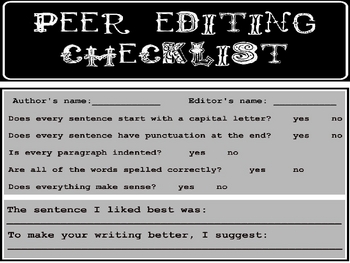
Peer Editing Checklist
What is peer editing? Peer editing is working with someone to help improve, revise, and edit his or her own writing. When you are editing someone's writing, there are several different things to take into consideration. There are three steps in peer editing to use as guidelines. First step is to compliment. Always start out by giving them a compliment on their writing and tell them what they did well on. You don't want to be a Picky Patty and pick apart their writing. You also shouldn't be a Mean Margaret and give them only negative feedback. Second step is to give them some suggestions. You should give the person's writing that you are editing some specific ideas about how to make his or her writing better. Don't be frightened to do this. Give them suggestions on their word choice, organization, sentences, and topic. You can't be afraid to hurt their feelings, but just remember to stay positive. It's called constructive criticism.

The final step in peer editing is correction. Look at their grammar, spelling, and punctuation. Do they have run-on sentences or incomplete sentences? This is when you look at all the little details. Just remember, stay positive. You are helping them to become a better writer so that they can get the best grade possible. As you are writing, you can't see all the little mistakes you make. Therefore, it's always best to have someone look over your work. Just remember when you are peer editing someone's work or your work is being peer edited that you are helping each other to become better writers.

Technology in Special Education

Technology is special education has really affected the way it is taught in schools today. It has made a huge impact on special education students and a big difference in their lives. With the use of technology, students with special needs are able to learn better, faster, and more efficiently. Technology allows special education students to do things that they weren't able to do before. I think that it makes learning for them fun and really gives them the motivation they need so they don't feel too different from everyone else. I think that for teachers, technology is such a great thing for the special education program because teachers are able to communicate with their students much better. There is a better understanding for students and teachers of what is being taught and what the students are learning.

In my future classes, I can use technology in many different ways to teach my students that have special needs. For example, a student that is not able to be verbal can very easily communicate with computers. If a student is not able to see well, there are computer apps that can magnify the text. What if a student needs someone to read to him or her? That problem is easily solved with a pair of earphones and a computer app designed to read aloud and along with the book. Technology gives special education students the confidence they need to function and feel comfortable around other people in the everyday world.

Apple Apps for Special Education

Apple Apps
Picture Communication Symbols (PCS) Word Scramble App is a great app for students with Autism, Down Syndrome and language delays. This app can be used to practice spelling and vocabulary in a way that is fun. One of the things that I love about this app is that you can customize it to fit the needs of the student. For example, you can hide PCS symbols to focus on symbols that reinforce specific vocabulary words, letters, or phonology sounds. You can also turn the text labels off to practice listening skills as well. The word scramble decks include three letter words, four letter words, all the way up to eight letter words. There is a picture that goes with each word that is shown. The letters to the word are given to the student, but they are scrambled. The object is to spell the word out correctly.

PCS Word Scramble App would definitely improve learning, especially with a student that has special needs. It would help improve their vocabulary, spelling, speech, and their recognition skills. I would definitely use this in my classroom.

Harness Your Student's Digital Smarts

Vicki Davis, a teacher in Georgia, uses wikis, blogs, podcasts, virtual worlds, and other new media tools to connect her students with the world. With the use of all this different technology and media tools, she has created a learning environment that is fun for her students. They are able to communicate and share their ideas with people from all around the world. It really does open up students' learning capabilities because they have so many different resources available to them with the use of technology.

Vicki Davis stated in her video that with pencil and paper, only a certain kind of student is able to learn and succeed. With technology, every student is able to reach their full potential because technology is designed to fit everyone's needs no matter what kind of a learner you are. She also stated that many teachers veer away from the use of technology because they themselves do not know how to use it and they feel that they should know everything because they are the teachers. It's okay if your student teaches you something that you didn't know. It does not make you any less of a teacher.

I really do think that with the use of technology and the many different media tools we have available, teachers are able to teach better and more efficiently to their students. As a result, students are more involved in the learning process and actually enjoy it. Therefore, more students are more likely to succeed and become successful adults.

Sunday, September 9, 2012

Blog Post #2

1. Did You Know?

Watching the video "Did You Know?" was an extreme eye opener. It's obvious that technology and people are advancing and becoming smarter everyday. Twenty-five percent of the population in India with the highest IQ's outnumbers the entire population of the United States. That means that India has more honor roll students than the United States. Are you kidding me? Apparently not. The fact that a super computer will be built that exceeds the computational capabilities of the human brain in the year 2013 really blows my mind. It scares me to think that technology is becoming smarter than humans.

I have realized that as I am preparing myself to be an educator, I need to be thinking about the things I am going to teach my students. With the world and technology advancing so rapidly, I am going to have to prepare my students for jobs that doesn't exist yet. I am also going to have to be ready for any questions and comments that my students have, because not only is technology advancing, but people are advancing as well. It seems as though I am going to have to be one step ahead of the game in order to be a successful educator in this very busy technological world.

2. Mr. Winkle Wakes

Mr. Winkle Wakes is about an old man waking up after 100 years of sleeping to find that the world had changed. Everything had changed except for one thing. He noticed all the busy people with their very busy machines. These machines were able to print pictures and documents on paper very quickly. In hospitals, he noticed there were X-rays and machines that kept people alive. He was overwhelmed by all the new technological advances. Then he went to school and immediately felt comfortable. Nothing had changed. The teacher stood in front of the class and lectured while students sat quietly taking notes. Mr. Winkle felt and ease of comfort because school had not changed.

This video holds very true with schools today. With all the advancing technology, it seems as though schools are having a hard time catching up. Therefore, children are falling behind. We cannot allow our children to fall behind because they are our future leaders. They are going to be the people running our country. One of our job as educators is to give our students access to different resources to help them learn. Technology is a fantastic resource to use for anything, especially education. Children have lost interest in school because nothing ever changes. There are no surprises, nothing to grab their attention. With the right technology in schools, teachers would be able to explore and introduce new ideas to their students and teach them in a way that has never been taught before.

3. The Importance of Creativity

Sir Ken Robinson makes an extreme eye-opening video about the importance of creativity in education. He says that education is meant to take us into a future that we can't grasp. He believes that creativity is as important to education as literacy is. He says that children will take a chance because they are not afraid of being wrong. As we become adults, we fear being wrong and do not want to make mistakes. In today's schools, children are being taught that making a mistake is the worst thing you could do. Schools are killing children's creativity by teaching them this concept. In the education system, Art is always the last subject to be taught on the list. In many school all over the world, dance and theatre aren't even taught. Public schools are based on two ideas. One, the most useful subjects for work are at the top. The second idea is academic ability. Apparently, everyone must be smart. This kind of thinking enables a child and lowers their confidence. Children are actually being taught that you have to be smart and perfect. Ken Robinson says that we need to rethink the fundamental principles in which we are educating our children. Our task is to educate children's whole being and to help them make something of their future.

I enjoyed watching this video. I thought that Ken Robinson made some very good points, and I agree with a lot of what he said. In today's schools, teachers are told to prepare their students for state testing. Therefore, teachers just cram an abundance of information into their students and students basically regurgatate it back on tests. As a consequence, students quickly forget the information because all they did was memorize. They didn't learn anything. I think our education system definitely needs to be re-thought out. It is our job as educators to prepare our students for the future and invoke creativity. Creativity is so important in education. It brings out new ideas, new thoughts, and new adventures. It opens up a whole new world. I strongly believe that if we incorporated more arts into our teachings that students would learn more and actually retain what they are being taught.

4. A Day Made of Glass

A world made of glass absolutely amazes my mind. The video demonstrated what the world will look like with the new advances of glass and technology. It will be apart of your everyday life. It will be in our homes, cars, hospitals, parks, and schools. This new glass technology will be everywhere. The amount of information that can be transferred from worlds away simply through glass is mind-blowing. This new technology will change the world and the way people live.

When I think about education and this new technology that they are creating, it would open up so many opportunities for children when used in schools. Everything you are teaching on the board in the front of the classroom is transferred straight to the student's tablets in front of them. the students are able to interact with one another on a huge activity board in which they can manipulate. I think this new technology is going to take the education system to a whole new level entirely. I am extremely excited about these new upcomings and cannot wait until they are available in schools.

Sunday, August 26, 2012

About Me

My name is Ashley Zaworski and I am twenty-four years old. I was born in Mobile, AL and moved to Mississippi with my dad when I was eight after my parents got a divorce. I was raised in Gautier, MS. I have one brother, two sisters, and two nieces. I help my sister Heather take care of her two girls. They are my heart. I have been there sinc they were born. I'm basically their second parent. Taylor is four and Aubreigh is two.
I work at Pascagoula Walmart as a cashier. That's usually where I am at when I'm not at school. I love school and I love kids. So of course it would make sense that I want to be an elementary teacher. I love spending time with my family and hanging out with my friends. Although, I really don't get to do much of either due to my crazy schedule. I have a girlfriend whom I love very much! We have been together almost three years and I don't know where I would be without her. This is my life. This is me.
Randy Pausch on Time Management
I have learned that in order to have good time management skills, you need to have a plan. Your plan might change, but you need to have that basis for a plan. Also, it helps to make a To-Do list and break it down. And it's probably best to do the ugliest thing first to get it out of the way.